How Dualmint Prices Proof Into the Marketplace
.png)
In most financial markets, assets are not evaluated in isolation. They are evaluated in context: how long they have been operating, how consistently they have performed, and how much uncertainty remains around future cashflows. A business with a history of revenue is treated differently from one that has not yet produced it.
Crypto markets often flatten this distinction. Assets with very different operating profiles are grouped together under a single yield figure, as if performance history were incidental. Dualmint takes the opposite approach.
The Seasoned Asset marketplace exists to reflect how capital actually behaves once performance can be observed rather than assumed, and to encode that distinction directly into market structure.
[fs-toc-h2] What “Seasoned” Means in Practice
A Seasoned asset on Dualmint is not a separate product. It is the same underlying real-world asset offered at a later point in its lifecycle.
To qualify as Seasoned, an asset must have:
- Been deployed and operating in the real world
- Generated recurring cashflow
- Produced measurable performance data
That data includes revenue consistency, uptime, and variance. The designation is based on observed operation, not simply the passage of time.
Seasoned does not mean risk has disappeared. It means uncertainty has been reduced by evidence. For allocators, that difference is material.
[fs-toc-h2] Why the Marketplace Separates New and Seasoned Assets
Traditional markets differentiate between early deployments and proven vintages for a reason. Performance history affects pricing, cost of capital, and allocation decisions. Treating assets at different lifecycle stages as interchangeable obscures information investors rely on.
Dualmint makes this distinction explicit by separating:
- New assets, where performance is expected but unproven
- Seasoned assets, where performance has been observed
This allows participants to choose exposure based on their own tolerance for uncertainty, rather than relying on averages that mask meaningful differences.
[fs-toc-h2] From Real-World Performance to Onchain Price
Real-world assets generate cashflow off-chain. Pricing decisions are informed by that activity. The challenge is ensuring that prices used on-chain reflect verified performance rather than internal estimates or discretionary updates.
Dualmint uses Chainlink’s decentralized oracle infrastructure to independently verify pricing inputs before they can be written onchain and used in the marketplace.
Before a price can be recorded on-chain and used in the marketplace, it must be independently validated via Chainlink’s decentralized oracle network. If a price is missing, stale, or unverified, marketplace transactions referencing that price will not execute.
This means:
- Prices used in the marketplace are independently verified
- No single party can override or bypass validation
- Pricing reflects observed performance before it affects on-chain activity
Chainlink functions here as infrastructure, not ornamentation. It enforces the rule that performance must be verified before it can influence price.
[fs-toc-h2] Why Settlement Happens on Arbitrum
Once prices are verified, settlement occurs on Arbitrum. The choice is not cosmetic. Arbitrum provides predictable execution, lower transaction costs, and Ethereum-grade security—properties that matter when pricing enforcement is mandatory rather than advisory.
In practice, this allows Dualmint to:
- Enforce price verification at execution time
- Scale marketplace activity without prohibitive costs
Maintain consistent settlement guarantees as asset count grows
Arbitrum serves as the execution layer where verified data becomes enforceable state.
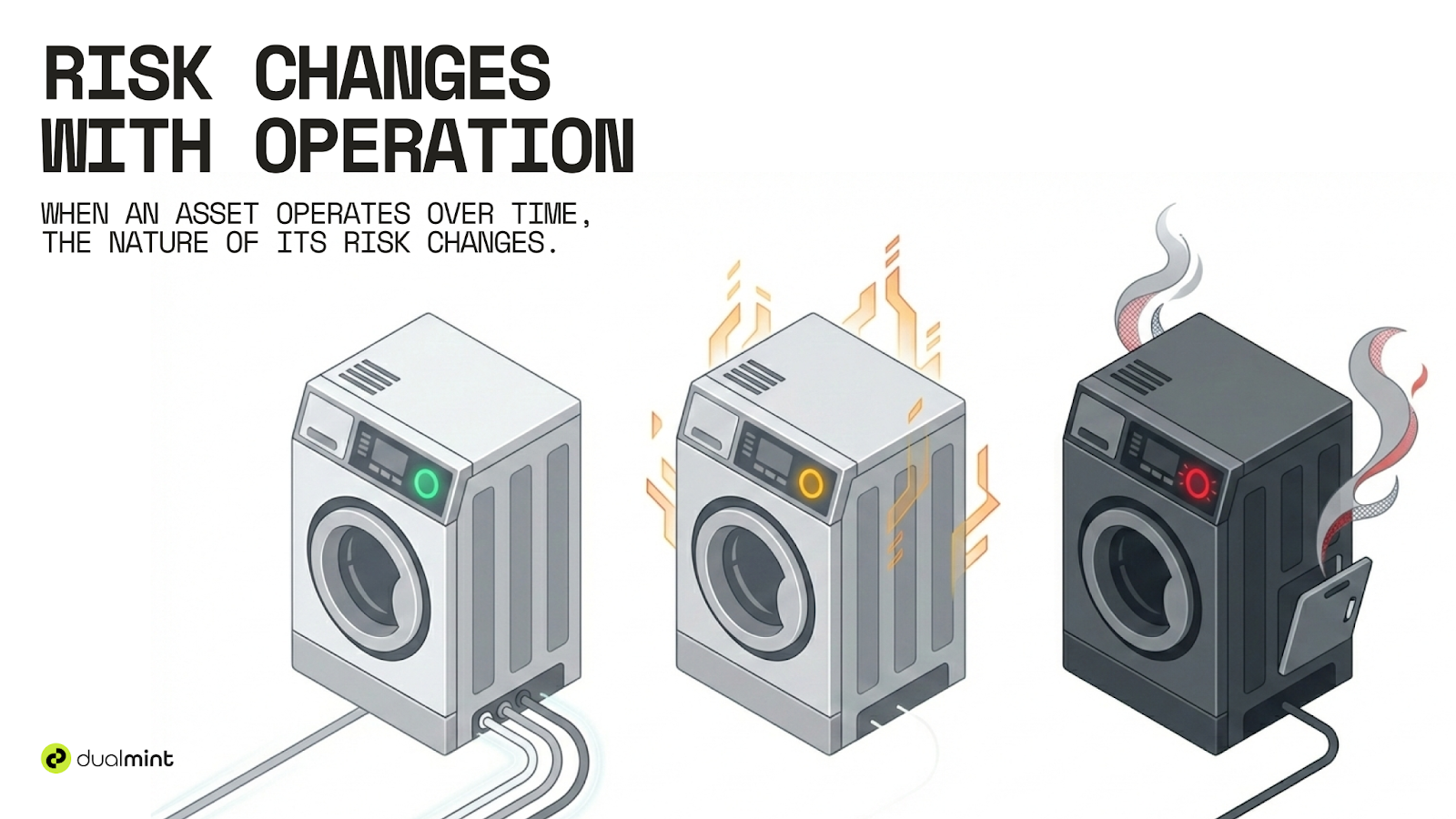
[fs-toc-h2] How Risk Changes with Operation
Risk is not static. It evolves as assets move from deployment to operation.
Early in an asset’s life, uncertainty is structural:
- Will usage match expectations?
- Will the operator execute reliably?
- Are assumptions about cashflow accurate?
As an asset operates, those questions narrow. Revenue patterns become visible. Variance can be measured. Cashflow timing becomes predictable within a range.
This does not remove downside risk, but it constrains it. In asset-backed markets, that constraint often determines whether capital remains exploratory or becomes repeatable.
Seasoned assets represent the point at which pricing shifts from projection to observation
[fs-toc-h2] Pricing Reflects Information, Not Incentives
Seasoned assets may be priced differently from New assets. This is not an incentive mechanism. It reflects information availability.
Pricing incorporates:
- Historical operating data
- Measured cashflow performance
- Observed variance and consistency
In most asset classes, assets with verified performance histories trade differently from first-time deployments. Dualmint applies the same logic on-chain, with Chainlink ensuring that the data informing prices is independently verified and Arbitrum ensuring that enforcement is reliable.
Investors allocating to New assets underwrite uncertainty in exchange for earlier exposure. Investors allocating to Seasoned assets underwrite observed performance. Both approaches are valid. They serve different preferences.
[fs-toc-h2] Continuity, Not Turnover
Seasoned assets also serve a structural role in the marketplace. When New assets reach capacity, Seasoned assets provide an immediate alternative for deployment. Capital does not need to wait for new issuance to remain active.
Over time, this creates a familiar pattern:
- Initial exposure through New assets
- Increased allocation into Seasoned assets
- Concentration around assets with consistent performance
This mirrors how capital behaves in established markets.
[fs-toc-h2] Lifecycle, Not Hierarchy
Seasoned assets are not superior to New assets. They represent a later phase in the same lifecycle.
New assets address deployment risk.
Seasoned assets address operating performance.
Separating them ensures pricing, expectations, and communication remain aligned with observable outcomes.
[fs-toc-h2] Summary
Seasoned assets exist because performance history changes how capital allocates. Operating history, measured cashflow, and visible variance matter.
Dualmint’s Seasoned Asset marketplace formalises that transition, from deployment to operation, by requiring independent verification through Chainlink and enforcing execution on Arbitrum before prices can influence on-chain activity.
New assets support early participation.
Seasoned assets support repeat allocation.
Both reflect how markets actually work.